
Early warnings. Better visits.
For Crohn's & Colitis
Know something's coming before you feel it. Flarity only notifies you when your body shows signs of change, then turns weeks of data into the report your GI wishes every patient had.
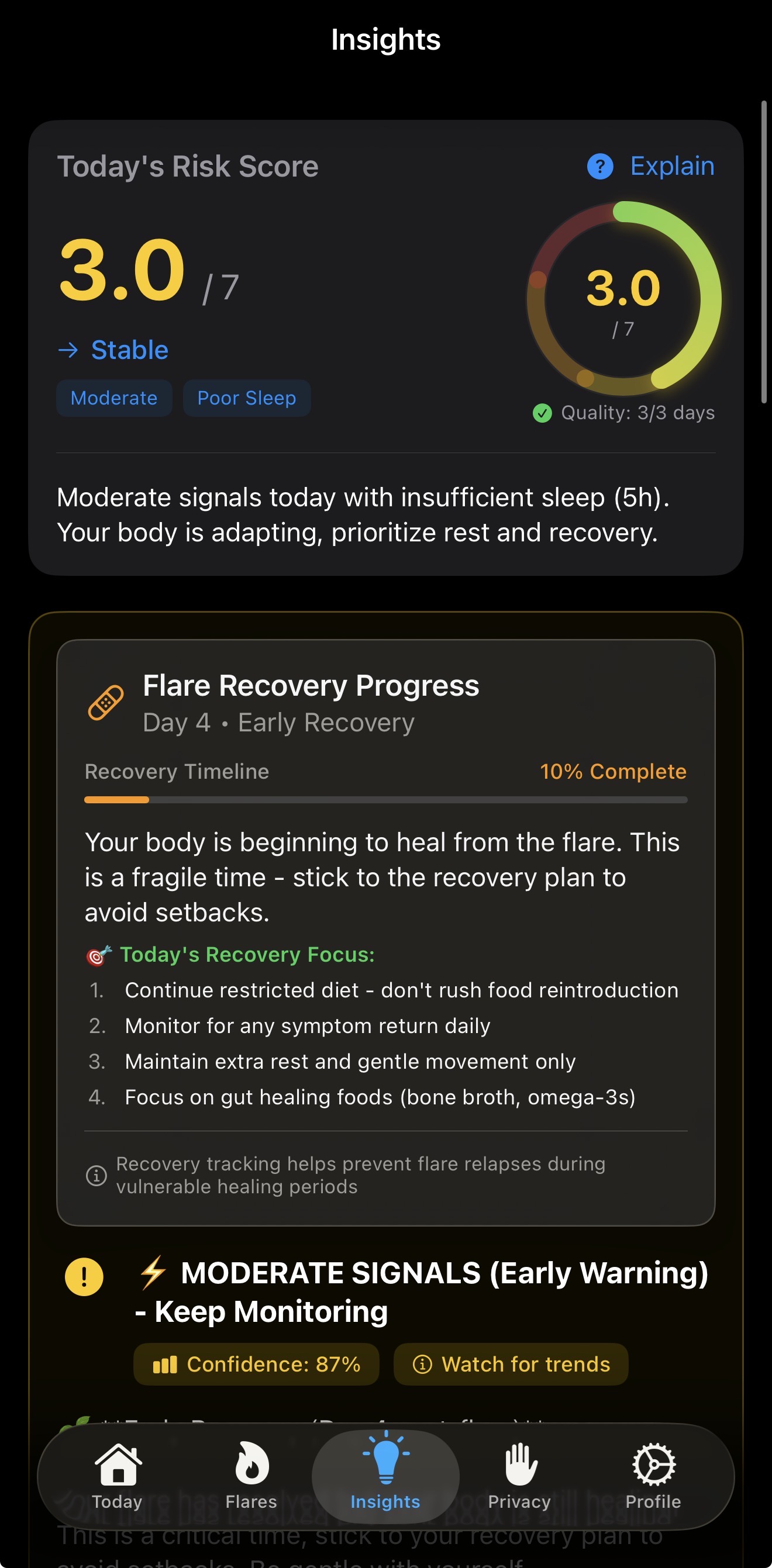
*Mount Sinai research showed 7 weeks. Flarity uses a conservative 4-week window for real-world accuracy. Learn why
For the first time, I walked into my appointment prepared.
I finally feel heard by my doctor.
This is what I needed when I was diagnosed.
The Gap Between Appointments
You forget what happened. Your doctor has 15 minutes. Flares hit without warning. You walk into appointments reconstructing weeks of symptoms from memory, and your GI makes decisions with incomplete data.
Paper diaries are abandoned. Symptom apps create survey fatigue. You deserve better.
Two layers.
Clinical-grade accuracy.
Flarity combines objective wearable data with subjective symptom input. This is how gastroenterologists diagnose: biomarkers plus symptoms. Now it's yours.
Wearable Detection
Your Apple Watch continuously monitors HRV, heart rate, sleep, and activity. When patterns deviate from your baseline, we detect physiological stress before you feel symptoms.
Smart Symptom Check-In
When signals warrant it, we ask a quick 30-second question. Pain level, bowel frequency, energy. Simple inputs that complete the clinical picture.
Combined Risk Score (0-7)
Wearable data + symptom confirmation = the same methodology your GI uses. Full accuracy, no guesswork.
Why this matters: Wearables alone can't assess pain or urgency. Symptoms alone rely on imperfect memory. Combined assessment (like labs plus exam) gives you the full picture. This is exactly how your gastroenterologist diagnoses. Now it's in your pocket.
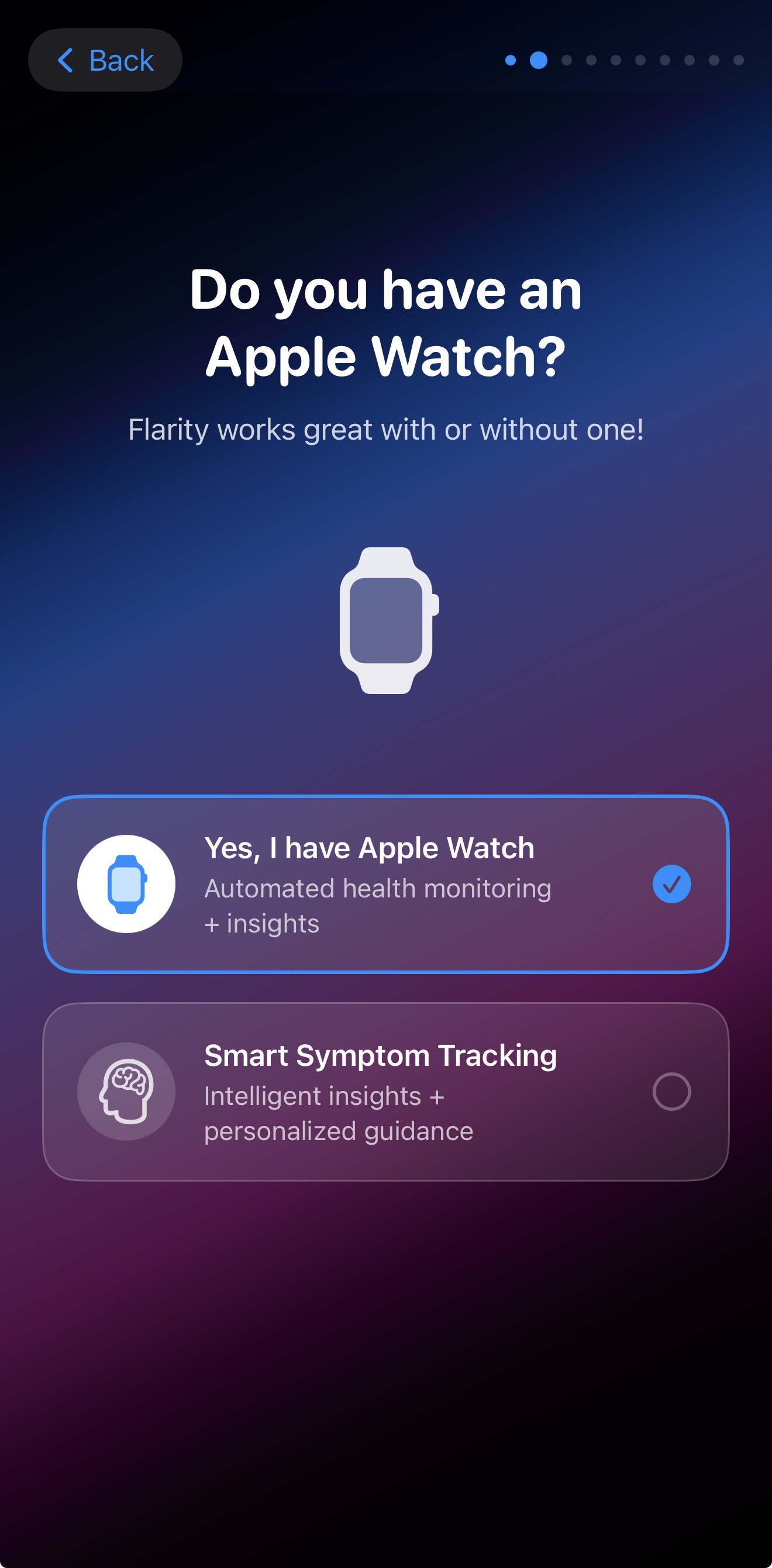
No Apple Watch? No problem.
iPhone-only mode uses symptom patterns and phone health data. You still get prediction, just with scheduled check-ins instead of signal-triggered ones.
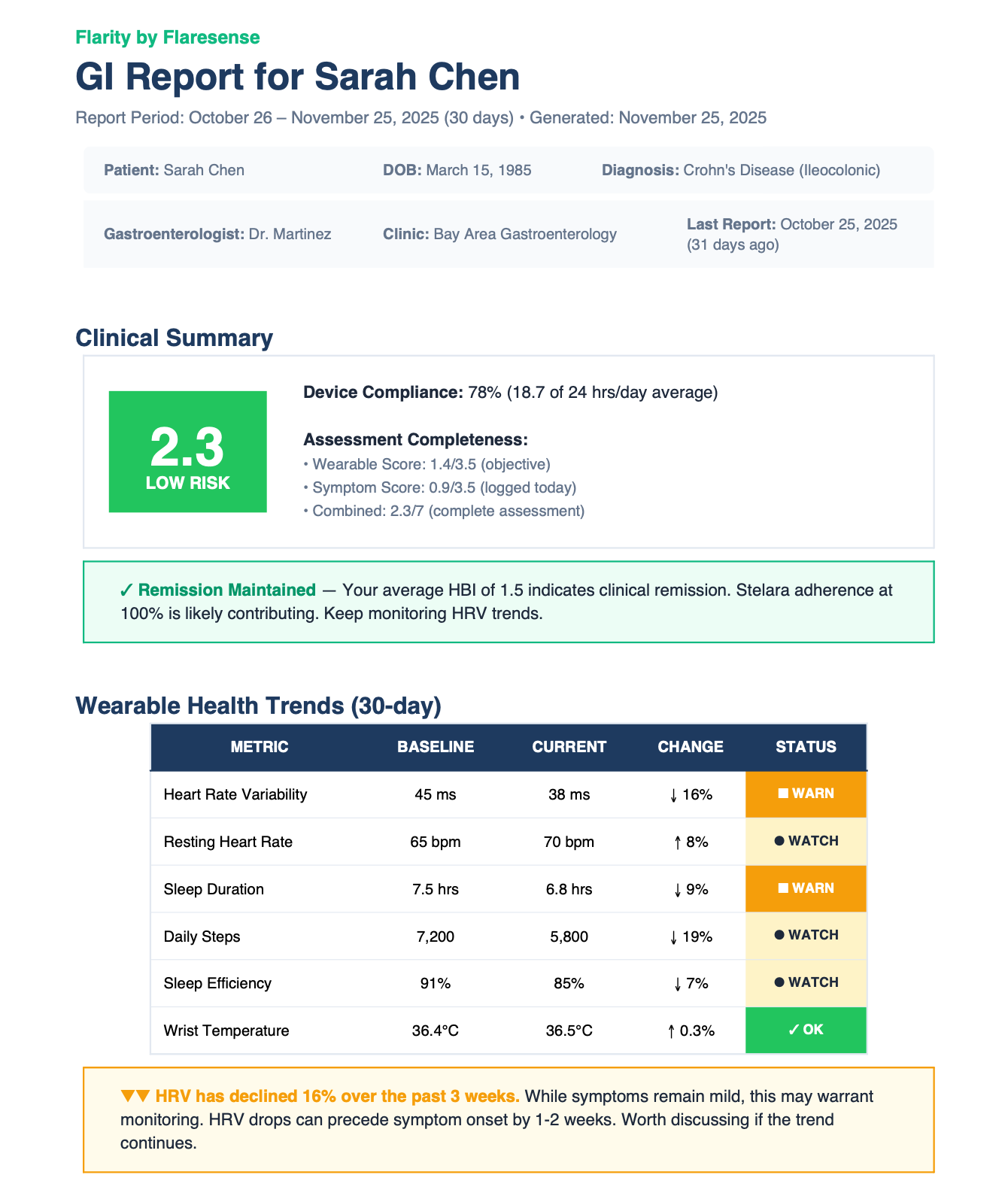
The Report Your GI Actually Wants
Generate a 3-page clinical summary in 30 seconds. No more forgetting what happened between visits.
"I showed my GI the report and she asked why all her patients don't use this."
Auto-Generated Questions
Flarity doesn't give you generic questions. It analyzes your data and generates specific questions like:
"My severe flare happened while on Skyrizi. Could the timing relative to my doses matter? Should we consider checking trough levels?"
"My HRV dropped 18% but I feel okay. Could this indicate subclinical inflammation?"
"My average sleep is 5.4 hours. Is poor sleep making my IBD worse?"
These questions are computed from your actual health patterns, not templates.
What's In The Report
Executive Summary
- Current status (Remission/Recovering/Active Flare)
- Risk score with wearable vs symptom breakdown
- Vitals trends table (HRV, RHR, Sleep, Steps)
- Recent flare summary
Clinical Details
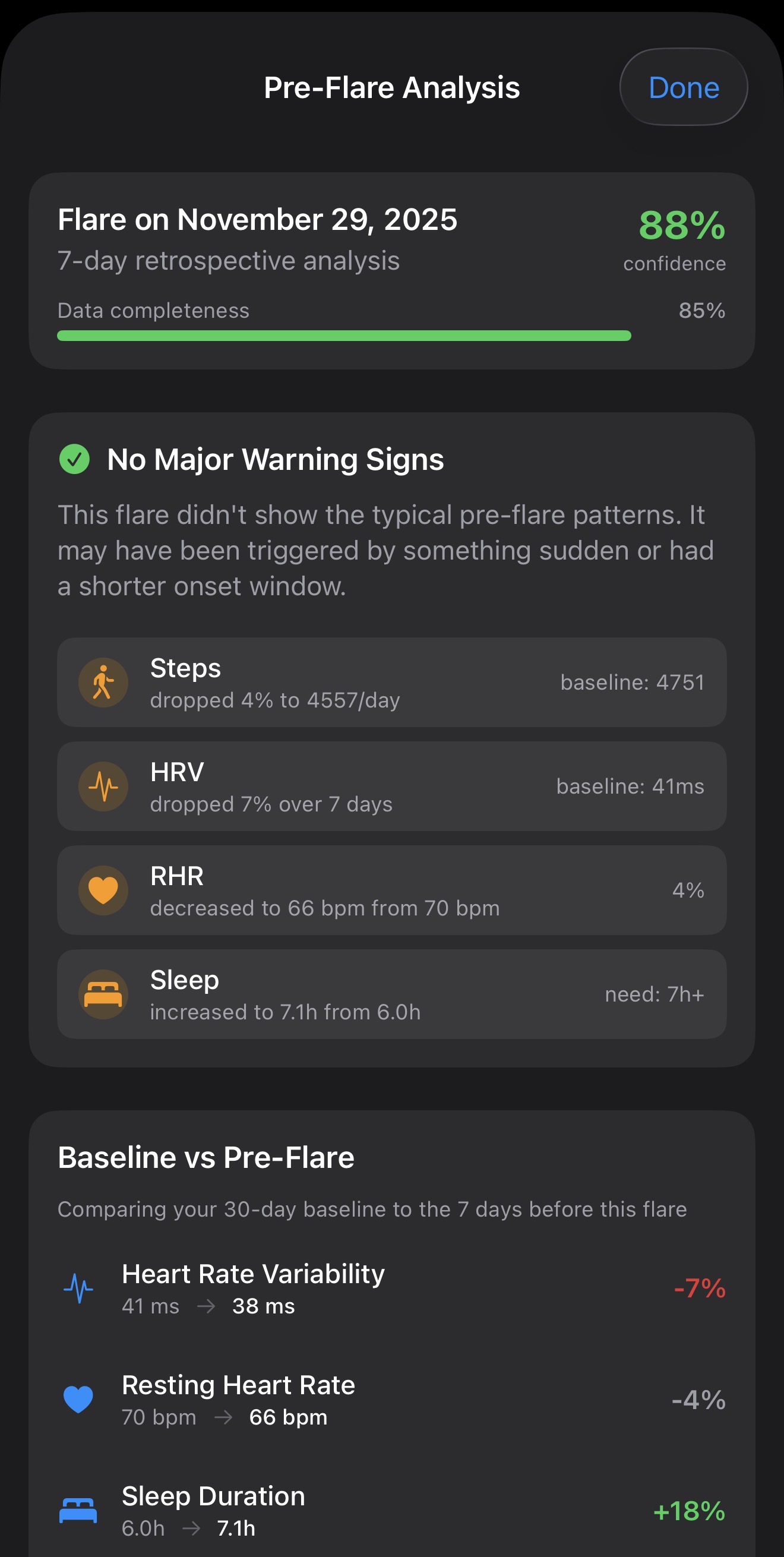
- Pre-flare biomarker analysis (confidence %, data completeness)
- Medication list with adherence percentages
- Historical medications
- HBI/SCCAI score history
Actionable Insights
- Personalized recommendations based on YOUR data
- Auto-generated questions for your GI
- Pattern-based insights from health data
- Next steps and areas to discuss
What to Expect
Flarity learns YOUR body. Here's how the first month works.
Setup
- Connect your devices
- Add medications
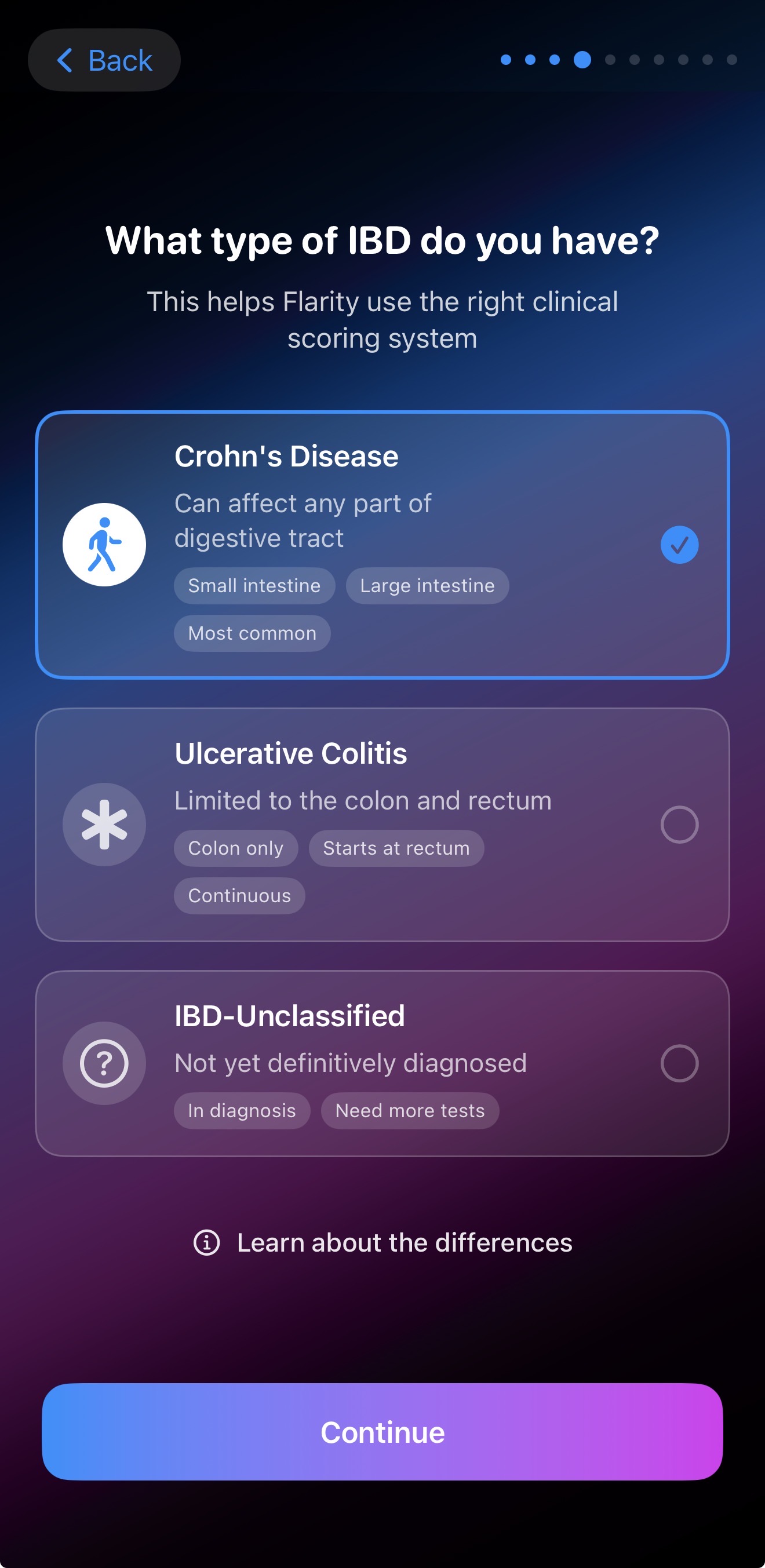
- Enter diagnosis details
Time: 10-15 minutes once
Learning
- Flarity observes your patterns
- Log any symptoms or past flares
- Complete your first HBI/SCCAI
Daily effort: Nearly zero (passive)
Predictions
- Smart prompts when your body shows changes
- Personalized risk scores
- Generate your first report
Daily effort: ~30 seconds when prompted
| Activity | Frequency | Time |
|---|---|---|
| Setup | Once | 10-15 min |
| Quick check-in | When prompted | 30 seconds |
| Log medication | Daily (optional) | 5 seconds |
| Generate report | Before appointments | 30 seconds |
This isn't a daily journaling app. Flarity works in the background. You only engage when it matters.
Just Diagnosed?
The first months are overwhelming. You're Googling symptoms at 2am, wondering what you can eat, scared of what's coming. Flarity can't make IBD easier. But with Flarity comes clarity.
- Start tracking from day one. Most patients wish they'd tracked earlier.
- Build a history your GI can use. Data from the beginning, not fuzzy memories.
- Learn what YOUR normal looks like. So you know when something's off.
- Walk into appointments prepared. Information, not just fear.
"When I was diagnosed, I was completely lost. This is the app I wish existed."
Rajan, Founder
Read Our Guide for Newly Diagnosed PatientsYour entire journey.
One app.
From setup to daily insights to 1-tap reports. Simple, powerful, private.
What Flarity Does
For You
Early Warning
Spot flares up to 4 weeks before symptoms. Based on Mount Sinai research showing signals up to 7 weeks early. Your Watch detects shifts in HRV, heart rate, and sleep.
Pre-Flare Analysis
Log a flare (even from months ago) and instantly see what your body was doing in the days before. 91% confidence scoring on pattern detection.
Smart Prompts
When your Watch notices something, we ask a few quick questions. Not random surveys. Just 30 seconds when it matters.
1-Tap Reports
Generate a clinical PDF your doctor will love. Executive summary, vitals trends, med adherence, and auto-generated questions.
Medication Tracking
Log meds, track adherence, see how they affect your symptoms. Real percentages your GI can trust.
Private by Default
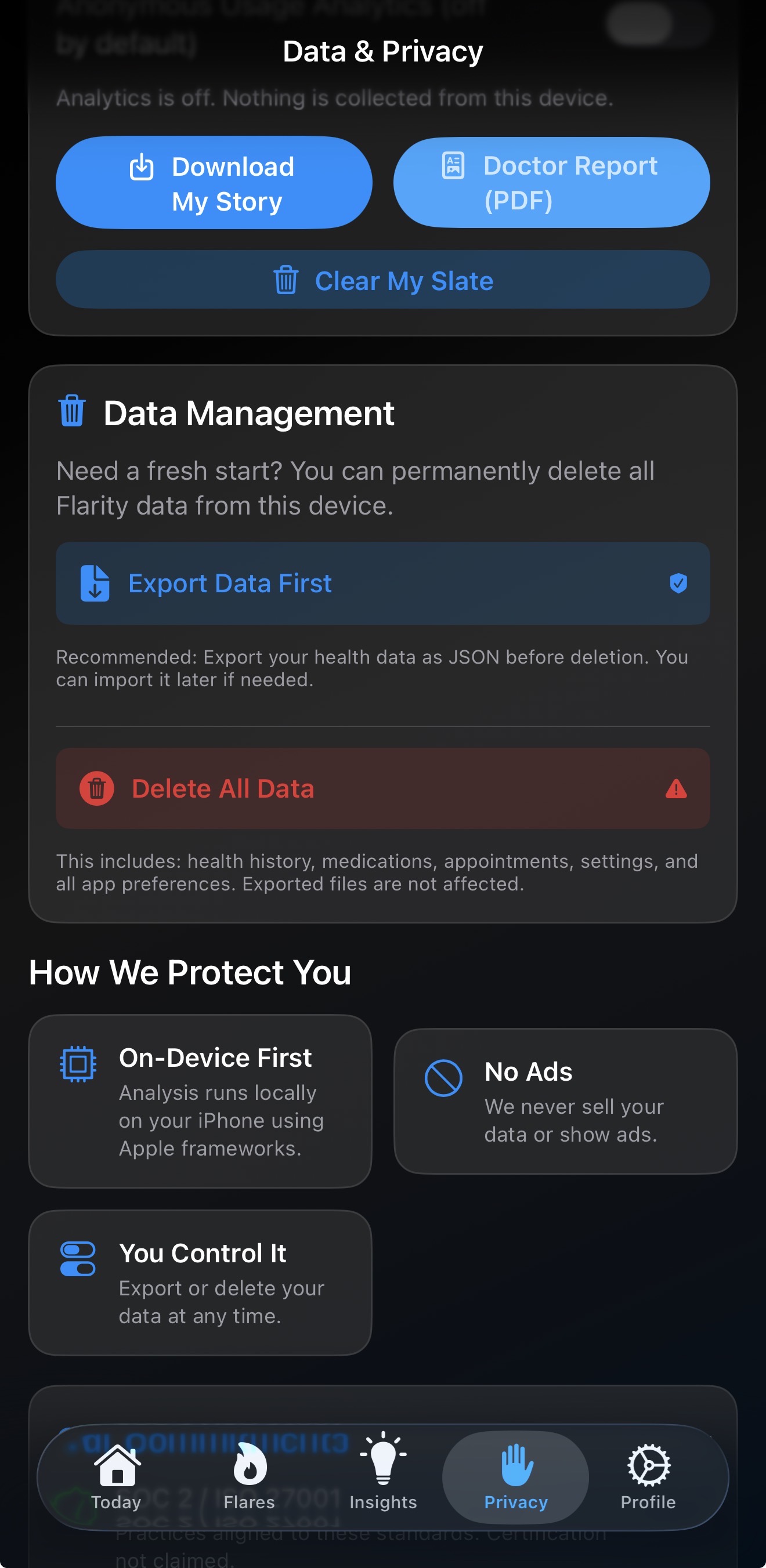
All processing happens on your device. We never see your health data. You control what gets shared.
Works with iPhone.
Even better with Apple Watch.
Flarity reads data from Apple Health, so it works with any health device that syncs there.
iPhone Only
iPhone (iOS 17+)
- Symptom tracking
- Medication adherence
- Clinical reports
- Pattern-based prediction (1-2 weeks)
iPhone + Wearable
Oura Ring, Whoop, Garmin, Fitbit
- Sleep trends
- Resting heart rate
- Activity patterns
- Improved accuracy
iPhone + Apple Watch
Apple Watch Series 4+
- HRV monitoring
- Wrist temperature
- Continuous data
- Up to 7 weeks early warning
Oura, Whoop, and Garmin sync sleep and resting heart rate to Apple Health, but not HRV. HRV is one of the strongest predictors of IBD flares, which is why Apple Watch provides the longest early warning window.
Built on Peer-Reviewed Research
Based on a 2025 Mount Sinai study of 300+ IBD patients, published in Gastroenterology, the leading peer-reviewed journal in gastroenterology. The research demonstrated wearable signals can detect flare patterns up to 7 weeks before symptoms appear.
Flarity implements a conservative 4-week prediction window for real-world accuracy. We'd rather give you 4 weeks of actionable warning than 7 weeks of noise.
Real Patients. Real Stories.
I told my wife I'd delete it by Tuesday.
I'm still using it. As a beta tester, Flarity flagged patterns I would have missed entirely. My last GI appointment was the first one where I felt like I had something real to say.
Hard to argue with that.
I'm always exhausted. That's just life with IBD.
I don't have energy to manually log symptoms every day. I didn't want another app that guilt-trips me when I skip a week. I definitely didn't want to fill out forms in the waiting room while brain-fogged and cramping.
Flarity runs in the background. It prompts me only when something matters, and even then, it's 30 seconds. Before my appointment, I tap one button and hand my GI a full report.
This is the first health app that understands that sick people are tired.
When I was diagnosed, I was completely lost. My doctor recommended surgery. I wanted to try medications first. That disagreement started a years-long journey through Inflectra, then Entyvio, now Skyrizi.
Every appointment felt like starting over. "When did symptoms start?" I don't know. "How bad was it?" Bad enough that I'm here.
I built Flarity because I was tired of guessing. I wanted warning before a flare hit. I wanted to walk into appointments with evidence, not fragments of memory.
This is the app I wish existed when I was diagnosed.
Walk into appointments
prepared.
Generate comprehensive reports your gastroenterologist will love. No more relying on memory.
1-Tap GI Reports
Generate a PDF summary with symptoms, trends, and medications in seconds.
Clear Trend Visualization
Show your doctor exactly what happened between visits.
Medication History
Track adherence and see how meds affect your symptoms.
Your Data, Your Control
Share only what you choose. All data stays on your device.
Built by a Crohn's Patient
Flarity was created by a Crohn's patient who's been through the ER visits, the scope preps, the uncertainty between appointments. After an ileocecal resection, he built the tool he wished existed: continuous monitoring that speaks his gastroenterologist's language.
This isn't a wellness app built by people who've never been sick. It's a clinical tool built by someone who knows what it's like to dread the next flare.
Simple, transparent pricing.
Choose the plan that works for you. All plans include a 21-day free trial. No credit card required.
One prevented ER visit pays for 10+ years of Flarity.
One work day saved during a predicted flare covers 3 months.
- Unlimited flare risk predictions
- Intelligent symptom prompts
- Unlimited PDF reports
- Advanced AI insights
- Medication tracking
- Flare timeline & patterns
- Priority email support
- All Monthly features
- Save over 3 months
- Priority support
- Early access to new features
- All Annual features
- Lifetime access (no renewals)
- All future updates included
- VIP support channel
21-day free trial on all plans. No credit card required to start.
What happens after you sign up:
- You'll get an email with download instructions
- 21-day free trial starts when you open the app
- No credit card required until you decide to subscribe
Common questions.
Everything you need to know about Flarity.
Why does Flarity market 4 weeks when the Mount Sinai study showed 7 weeks?
The Mount Sinai research published in Gastroenterology found that wearable signals can change up to 7 weeks before a flare. That's the scientific ceiling under ideal research conditions.
We chose 4 weeks intentionally. Seven weeks out, life is noisy: stress from work, a bad night's sleep, travel, dietary experiments. It's hard to distinguish early flare signals from normal fluctuation.
Four weeks hits the sweet spot: it's far enough ahead to actually do something meaningful (schedule a GI appointment, clear your calendar, stock up on supplies, adjust medications with your doctor), but close enough that the signal is real and actionable.
We'd rather give you 4 weeks of actionable warning than 7 weeks of noise. Underpromise, overdeliver. Especially when your health is on the line.
Is Flarity a medical device?
Flarity is a wellness app, not an FDA-cleared medical device. It's designed to help you track patterns and share insights with your care team, but it doesn't diagnose, treat, or replace professional medical advice. Always consult your gastroenterologist for medical decisions.
Do I need an Apple Watch?
Apple Watch provides the best experience with continuous health monitoring, but it's not required. iPhone-only mode uses symptom patterns and phone health data. You still get prediction, just with scheduled check-ins instead of signal-triggered ones.
Manual logging still powers pre-flare analysis, medication tracking, and full GI reports - everything your doctor needs to see.
How accurate are the predictions?
Flarity is built on Mount Sinai research that demonstrated wearables can detect flare signals up to 7 weeks in advance. Accuracy improves over time as the app learns your personal patterns. We combine objective wearable data with your symptom input for clinical-grade assessment.
Is my data safe?
Yes. All processing happens on your device. Your health data never leaves your phone unless you explicitly choose to share it. We use end-to-end encryption for any data you choose to share with your care team.
Can I share data with my doctor?
Absolutely. Generate comprehensive PDF reports in 1 tap and share them directly with your gastroenterologist. Reports include your risk trends, symptom patterns, and insights that help your care team make informed decisions.
What medications can I track?
Flarity tracks adherence for any IBD medication: biologics (Humira, Remicade, Stelara, Entyvio, Skyrizi, Rinvoq), 5-ASAs (mesalamine, Lialda, Pentasa), immunomodulators (azathioprine, 6-MP, methotrexate), steroids (prednisone, budesonide), and supplements.
What if I'm in remission?
Flarity is valuable during remission too. It helps you maintain awareness of subtle changes that might signal an upcoming flare, giving you the best chance to stay in remission longer through early intervention.
Can I cancel anytime?
Yes. Cancel through the App Store at any time. No questions asked. Your data stays on your device.
What devices does Flarity work with?
Flarity works with any iPhone running iOS 17+. It reads health data from Apple Health, so any device that syncs there can improve your predictions.
Apple Watch provides the most complete experience - HRV, continuous heart rate, wrist temperature, and sleep stages give you up to 7 weeks early warning.
Oura Ring, Whoop, Garmin, Fitbit sync sleep and resting heart rate to Apple Health. These improve accuracy but don't include HRV (due to technical differences in how it's calculated), so the early warning window is shorter.
iPhone only still works great for symptom tracking, medication adherence, clinical reports, and pattern-based predictions.
How does Flarity generate questions for my doctor?
Flarity analyzes your actual health data and generates specific questions based on patterns it detects:
Therapy effectiveness: Multiple flares despite good adherence? It asks about drug levels and antibodies.
Alarming symptoms: Blood in stool? It suggests asking about calprotectin or scoping.
Wearable insights: HRV dropping while you feel fine? It asks about subclinical inflammation.
Lifestyle factors: Poor sleep? It asks about the bidirectional relationship with IBD.
Follow-up timing: Surgery anniversary approaching? It suggests surveillance tests.
These aren't templates. They're computed from YOUR data.
How long until Flarity starts predicting flares?
About 2-3 weeks. Flarity needs time to establish YOUR personal baseline: what's normal for your heart rate, sleep, and activity. After that, it can detect when patterns deviate and warn you before symptoms appear.
How much time does this take daily?
Almost none. Flarity runs in the background. You'll get prompted for a 30-second check-in a few times per week (only when your body shows changes). Logging medications takes 5 seconds. That's it.
This isn't a daily journaling app. It's designed for people who are tired.
What if I'm newly diagnosed?
Flarity is actually perfect for newly diagnosed patients. Starting early means:
• You build a health history from day one
• Your GI gets data from the beginning, not just after years of flares
• You learn what YOUR baseline looks like
• You walk into appointments prepared, not overwhelmed
What if I'm in a flare right now?
Flarity helps most with prediction. If you're currently struggling:
Call your GI if:
• Symptoms persist 2+ days without improvement
• You need medication adjustments
Go to the ER if:
• Severe abdominal pain getting worse
• Heavy or persistent blood in stool
• Fever over 101°F (38.3°C) with chills
• Can't keep fluids down 24+ hours
• Signs of obstruction (severe pain, rigid abdomen, vomiting)
How Flarity helps: Log your flare (even retroactively) to improve future predictions, and generate a report documenting what happened.
When in doubt, call your GI's office - most have after-hours lines.
Can my employer or insurance company see my data?
No. Your data lives on your device, not our servers. We don't share with third parties. Reports only go where you explicitly send them. We can't produce data we don't have.
Get Flarity first.
Join the waitlist. Help shape the future of IBD management.